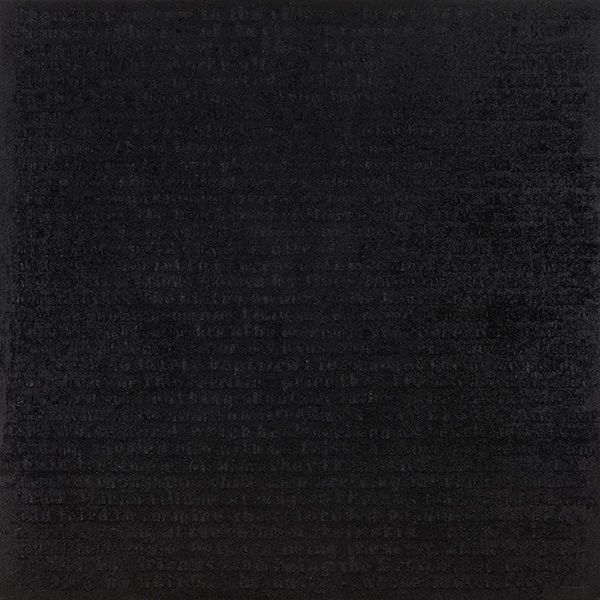
Across the dark surface of_ Stranger #55_, faint lines of text begin to appear. At first the words seem legible, but as the lines continue, they become harder to decipher, dissolving into layers of black marks and texture.
The text comes from a 1953 essay by the writer James Baldwin titled Stranger in the Village. In the essay, Baldwin recounts his time living in a small Swiss mountain village where many residents had never encountered a Black person before. He describes the strange experience of being visible yet never fully seen.
For Glenn Ligon, Baldwin’s writing has remained an essential point of reflection. Over the course of his career, Ligon has repeatedly returned to Baldwin’s texts, finding in them a language that speaks to his own experiences and to broader questions about race and perception.
In Stranger #55, Ligon transfers Baldwin’s words onto the canvas using stencils and black oil stick. He presses the oil stick through the letterforms line by line. As the text spreads across the painting, the oil stick builds up through repetition, dragging across the surface and recording the physical act of making. But as the process continues, the words become increasingly obscured, and layers of coal dust are applied to the still tacky surface. Repeated applications of oil stick and coal dust create a deep black surface that is both luminous and gritty.
The words begin to blur, forcing us to work harder to find them, and even harder to make sense of them. This gradual loss of legibility is intentional. As the language breaks down, the viewer experiences the same tension Baldwin described in his essay, the feeling of being seen yet not fully understood.
As the words gradually dissolve into abstraction, Stranger #55 begins to resemble a monochrome painting, recalling the black-on-black works of the artist Ad Reinhardt. Reinhardt created paintings composed of subtle variations of black in pursuit of purity through abstraction and reduction, removing imagery and information to create work that was demanding and timeless.
But Ligon shifts that tradition. Instead of removing history and meaning, he embeds them within the surface of the painting. By inserting Baldwin’s words into the canvas, Ligon brings together monochrome abstraction and Black literature, linking the history of painting with questions of identity, colonialism, and perception.
Like Baldwin’s experience in the village, Stranger #55 reminds us that the act of looking is never neutral, but shaped by the histories we carry with us.