Jazz musicians often describe improvisation as responding in the moment, when composition and performance happen at once. But
that freedom comes from deep knowledge, practice, and experimentation.
For Sam Gilliam, music shaped the way he approached painting. He often pointed to jazz musicians such as Miles Davis and John Coltrane as key influences. Like jazz, his paintings were dynamic compositions where material, process, and creativity worked together.
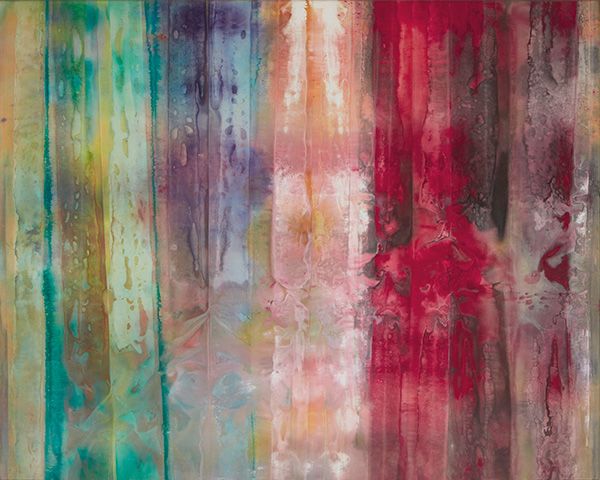
In Pac, bands of color move vertically through the canvas, bleeding into one another with soft ripples. Gilliam achieved these effects through a highly physical process. Instead of applying paint with a brush, he poured thinned acrylic paint directly onto raw, unprimed canvas, allowing the color to soak into the fabric. While the paint was still wet, he folded the canvas against itself. As the layers pressed together, the colors transferred and printed onto other areas of the surface. When the painting was finally unfolded, it revealed a combination of intention and chance.
Gilliam then stretched the canvas across a deep beveled frame that lifts the painting away from the wall, emphasizing the work as a physical object rather than simply an image.
Gilliam’s approach grew out of the Washington Color School, a group of artists working in Washington, D.C., from the late 1950s into the 1960s who explored nonrepresentational painting through new approaches to color and staining. But Gilliam pushed those ideas further. He poured, soaked, stained, crushed, and crumpled the canvas, closely observing how the materials responded.
In doing so, Gilliam expanded what painting could be. Rather than controlling every outcome, he worked with paint, fabric, and gravity, manipulating the canvas to shape the final composition. Much like jazz, it balanced technique with exploration and discovery.
At the same time Gilliam was developing these new approaches to painting, the United States was experiencing intense social and political change. During the Civil Rights era, many Black artists were expected to create work that directly addressed racial injustice through depictions of Black life. Gilliam’s commitment to abstraction challenged those expectations, yet he rejected the idea that his work existed outside political
meaning. As Gilliam later explained, “My work is as political as it is formal.”
In Pac, Gilliam brings together the influence of jazz and the possibilities of paint. Through color and process, the canvas becomes a space where discipline and improvisation meet.