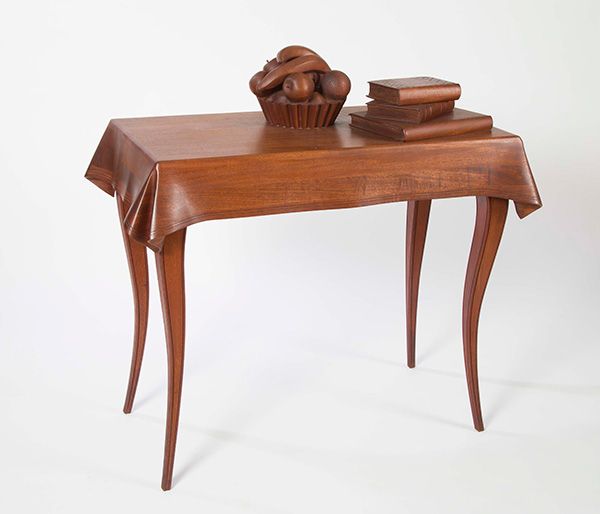
At first glance, Table with Fruit and Books appears simple: a table draped with a cloth, topped with a small stack of books and a bowl of fruit. But as we look closer, something unexpected begins to happen.
The cloth does not move. The fruit cannot be eaten. And the books will never be read. That is because every element has been carved from layered mahogany.
Here, Wendell Castle uses a technique known as trompe l’oeil, French for “to deceive the eye.” Seventeenth-century still-life painters used this technique to create the illusion of three-dimensional objects on a flat canvas. Castle reverses that tradition. Instead of painting objects that appear real, he carves hardwood that convinces us the tablecloth is soft, the fruit freshly gathered, and the books bound in worn leather.
To create this illusion, Castle combined traditional joinery with his own innovative woodworking method known as stack-lamination. Inspired in part by a nineteenth-century technique used to make wooden duck decoys, thin boards of wood are glued together into a large block. Castle then carves this mass much like a sculptor carving stone, carefully shaping each surface and texture. The table, cloth, fruit, and books are then joined together, allowing the entire work to emerge as a single sculptural form.
Through approaches like this, Castle would come to be known as the father of the American Studio Furniture, or American Art Furniture, movement. During the mid-twentieth century, artists led by Castle rejected mass-produced furniture and instead created works by hand in their own studios. Their goal was not simply to make useful objects, but to explore furniture as a form of artistic expression.
Though he originally studied industrial design, Castle quickly realized that traditional design work left little room for experimentation. As he later explained, the only way to make the unusual objects he imagined was to make them himself. Yet many of his early sculptures still resembled strange pieces of furniture.
With that surprising overlap, Castle began exploring objects that could exist somewhere between form and function. This idea would become central to the American Studio Furniture movement. By treating furniture as sculpture, Castle began creating objects that defied definition. Through his technique of stack-lamination, layering and carving solid wood, he could shape the material in ways that seemed almost impossible.
Combining the skills of a craftsman with the imagination of an artist, Castle asked one simple question early in his career: “Why couldn’t furniture be just as expressive and have every bit as much power and strength as sculpture?” Table with Fruit and Books invites us to consider that question.
What first appears to be an ordinary tabletop arrangement slowly reveals itself as something more—a work of art that exists somewhere between furniture and sculpture.