The sculptor and printmaker Elizabeth Catlett once said that her art should serve the people and reflect their dignity and strength.
For LaToya M. Hobbs, Catlett’s work became a guiding influence. Hobbs has often described Catlett as one of her “art mothers,” artists whose work shaped how she understood portraiture and the power of representing Black women with care and agency.
Hobbs grew up here in Little Rock, surrounded by creativity through church, music, and dance. Initially, she planned to study biology and become a pediatrician. But during her time at art should serve the people and reflect their dignity and the University of Arkansas at Little Rock, a professor recognized her artistic talent and encouraged her to pursue art instead. Through that mentorship, Hobbs first encountered Catlett’s work, which would profoundly shape her direction as an artist and her interest in woodcut printing.
A labor-intensive process, woodcut requires the artist to carve each line by hand into a wooden block using chisels. It is a physical process requiring both strength and precision. Hobbs often works at a monumental scale, carving multiple sections that must be inked and printed separately before being assembled into a single image.
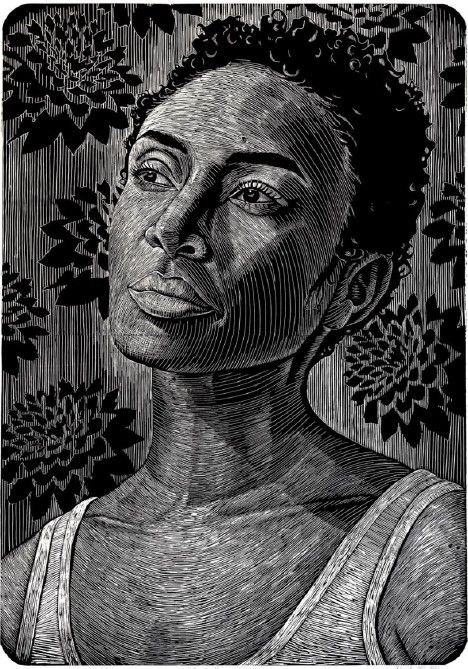
In Dahlias for Naima, we see Naima Mora, the granddaughter of Elizabeth Catlett, gazing into the distance with a quiet sense of poise and control. Hobbs portrays Naima decades after Catlett sculpted her as a teenager, presenting her now as an adult. The composition echoes the style of a photographic headshot, yet Naima appears in a simple tank top rather than formal attire. Naima described sitting for the portrait as an opportunity to strip away the public persona she developed as a fashion model and present a more authentic view of herself.
Behind Naima, a dense pattern of dahlias fills the background. The dahlia is the national flower of Mexico, where her grandmother, Elizabeth Catlett, lived and worked for more than sixty years. Naima once described her grandmother’s home in Cuernavaca, Mexico, as the place where she felt most at peace. Hobbs transforms that memory into a field of flowers that creates a space of calm and reflection.
Through this portrait, Hobbs connects directly to Catlett’s influence while continuing the work she began. Like Catlett, Hobbs challenges the long history in Western art where Black women were often ignored, stereotyped, or shown only in supporting roles. Instead, she creates space for self-definition.
In Dahlias for Naima, Hobbs presents Naima as she defines herself—grounded in strength, dignity, and the continuing legacy of a revolutionary artist.